
Doughnut Economy
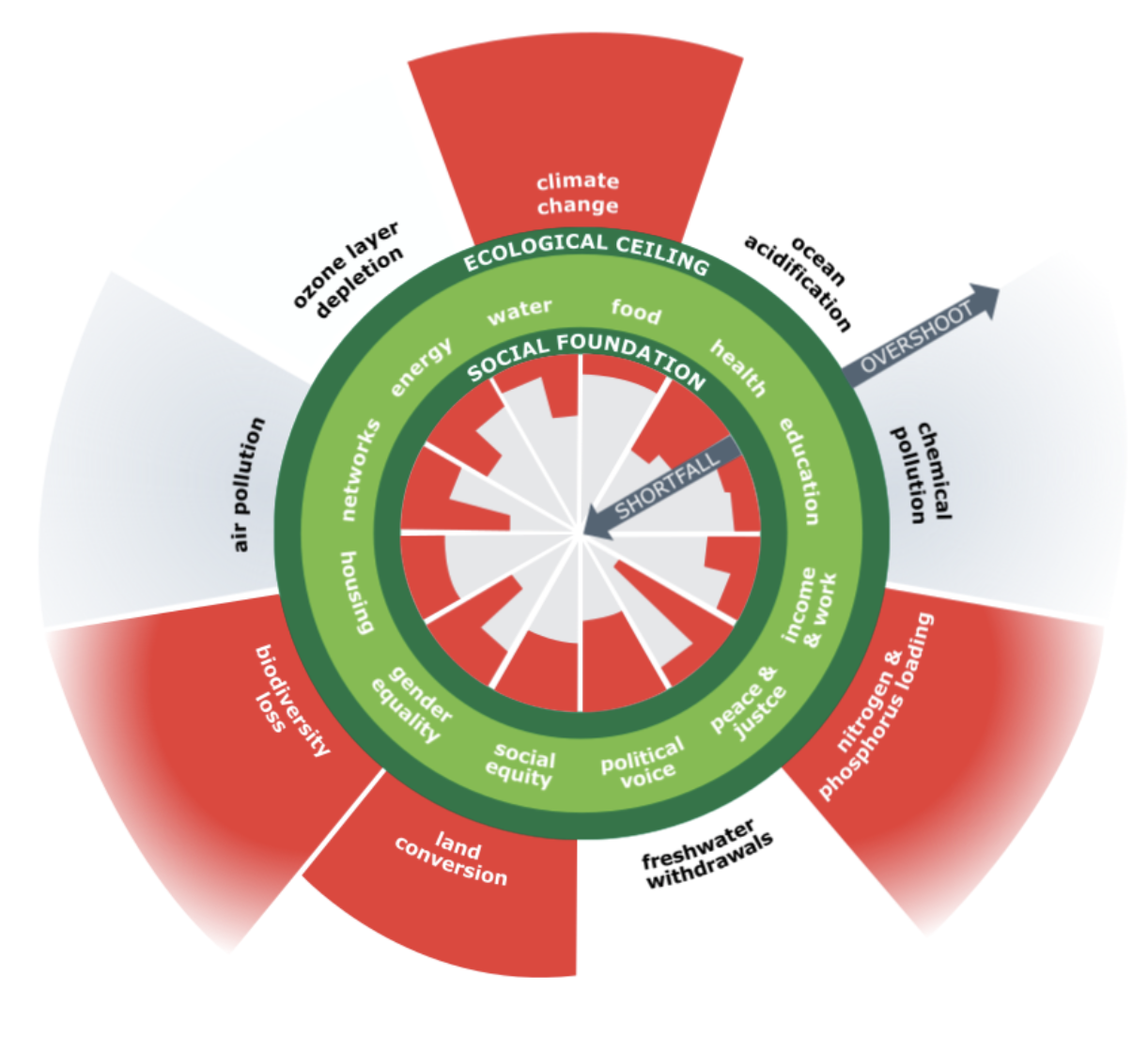
The British economist Kate Raworth, at the University of Oxford, developed the Doughnut model. It brings together two boundaries. The inner boundary is a social foundation: what no one should fall short of, such as food, housing, health and political voice, drawn from the UN Sustainable Development Goals. The outer boundary is an ecological ceiling, made up of the nine planetary boundaries (Rockström et al. 2009). Between them lies a space that is both ecologically safe and socially just (Raworth 2017).
In 2025, Raworth and Andrew Fanning measured how the world has changed since 2000, using 35 indicators. Global GDP has more than doubled, but the reduction of poverty is slow, while the overshoot of planetary boundaries is accelerating. The richest countries, home to 15 percent of the population, account for over 40 percent of ecological overshoot (Fanning and Raworth 2025, Nature).
For me, the Doughnut is a good compass. It shows that sustainability is not only about emissions, but about meeting people’s needs within what the planet can bear.
Sources
- Raworth, K. 2017. Doughnut Economics: Seven Ways to Think Like a 21st-Century Economist.
- Rockström, J. et al. 2009. A safe operating space for humanity. Nature.
- Fanning, A. and Raworth, K. 2025. Doughnut of social and planetary boundaries monitors a world out of balance. Nature.
- Doughnut Economics Action Lab.